Highlights
- Preserved the Isaac Sim CNN/Transformer learning pipeline and extended the project through ROS 2 perception, C++ planning/execution, and Gazebo contact experiments during 2026.
- Validated 11/11 expected reachable simulated arm goals with measured joint feedback; maximum terminal flange position error was 0.817 mm in that controlled Phase 3 set.
- Evaluated frozen action-to-release and sliding models on 64 held-out conditions, separating prediction error from controller goal error and simpler-baseline comparisons.
- Reproduced weak lateral contact transfer, diagnosed sliding, and confirmed a versioned two-cylinder correction on eight fresh unseen-seed conditions.
- Retained estimator, online-identification, and lifecycle failures. All manipulation results are simulated; general planar control and live per-object adaptation remain unvalidated.
Key metrics
Media
Tech stack
Research motivation
The project asks how visual observations, temporal learning, physical models, and explicit control contracts can work together in robotic manipulation. I developed the learning and integration code, experiment tooling, independent numerical checks, and failure analysis. Isaac Sim, ROS 2, MoveIt, Gazebo, and Warp provide the underlying frameworks.
All current robot and contact experiments are simulation-based. A simulated Panda reaching a goal, a learned trajectory matching data, and an object stopping near a target answer different questions and use different denominators.
Project evolution
The original 2025 study used Isaac Sim RGB/state sequences and a CNN/Transformer policy. Development continued in 2026 through offline model audits, ROS 2 RGB-D geometry and state estimation, C++ Panda planning/execution, differentiable sliding, frozen release models, and controlled pushing.
Phase 5 established camera-conditioned pushing with a global friction fallback. Phase 6A exposed poor directional transfer in the original contact fixture. Phase 6A.1 reproduced the failure, investigated contact geometry and solver behavior, and validated a separately versioned correction in a narrow domain. These later reports take precedence over older roadmap entries that still describe contact work as future work.
End-to-end system architecture
RGB-D observations and acquisition-time transforms feed object measurements and validity-aware state estimates. Independent C++ planning/execution authority validates robot state, controller readiness, collisions, provenance, and task bounds before submitting Joint Trajectory Controller actions. Gazebo supplies the simulated plant; timestamped observation/contact recorders supply evaluation data.
The ML environment is isolated from the ROS runtime. Differentiable models produce bounded proposals through explicit interfaces; they do not own the controller. Native simulator state is separately labeled as a safety/evaluation guard and is not silently treated as camera-only deployed sensing.
Vision-conditioned temporal learning
TemporalVisionFrankaPolicy encodes RGB images with a CNN, projects robot/scene state into the same embedding space, and fuses four context tokens with a two-layer, four-head Transformer. Separate heads predict eight future joint deltas and end-effector positions. The state includes joints, end-effector, object, target, and a time token.
Dataset preprocessing preserves episodes, supports episode-disjoint train/validation splits, and rejects discontinuous windows across resets. Rollout losses combine integrated joint prediction, end-effector trajectories, terminal error, smoothness, and joint limits. CUDA inference and architecture checks are reproducible; an untrained smoke checkpoint is explicitly not learned accuracy evidence.
- Historical figures and the Isaac Sim data workflow remain available. The earlier portfolio recorded 1.67 cm terminal and 1.37 cm mean end-effector prediction error with 976 ablation windows; original trained logs/weights are absent from the current source snapshot, so those labels remain historical and un-reproduced.
- Visual-property illustrations from the earlier portfolio are conceptual. They do not establish measured mass, force, or general physical-property estimation.
Differentiable physics
The later Warp model is an independent float64 planar-sliding surrogate. It integrates effective Coulomb friction, velocity-dependent smoothing, and optional drag. Tape gradients are checked against an independent NumPy implementation and finite differences on CPU and CUDA.
Differentiability applies to this approximate model, not Gazebo/DART contact discontinuities, MoveIt planning, or controller execution. Fitting unforced coast windows estimates effective friction; mass cancels from the unforced acceleration and is not identifiable from those observations.
RGB-D perception and state estimation
The ROS pipeline uses camera models, depth projection, TF2/SE(3) transformations, timestamps, covariance, and validity metadata. The constant-velocity estimator is named an EKF in the code, but its direct-position model is linear. It rejects malformed, stale, or statistically inconsistent updates and supports dataset replay and ROS bag workflows.
Filtering is not uniformly better: in the low-noise recorded annotation-proxy evaluation, EKF position RMSE was 0.115210 m versus 0.008718 m for raw observations. Abrupt annotated motion caused false rejection and failed reacquisition. Those are injected-noise proxy measurements, not calibrated physical RGB-D truth. Later known-cube geometry corrections and conservative uncertainty bounds are separately evaluated.
ROS 2 system integration
The Jazzy packages separate perception messages/nodes, C++ diagnostics, planning, execution, simulation, and contact tasks. System Python ROS dependencies remain separate from the PyTorch/Warp environment. Scene/session epochs and acquisition/receive ordering prevent stale observations from gaining actuation authority.
Replayed bags, synthetic fixtures, rendered Gazebo RGB-D, native truth, and recorded annotations retain different provenance. Full world-reset recovery requires a clean relaunch and a new intent; a lost action result is not counted as an acknowledged cancellation.
Motion planning and trajectory execution
The verified execution route uses C++17, the direct MoveIt planning pipeline, Gazebo Harmonic, ros2_control, and the Joint Trajectory Controller. Collision-aware plans are timed and independently checked before submission; completion uses fresh measured joints, forward kinematics, and TF rather than the command alone.
The primary Phase 3 suites contain 25 requests: 11 expected reachable goals succeeded, 10 deliberate invalid requests were rejected, and 15 submitted actions include two intentional cancellations and two reset interruptions. Maximum terminal flange position error was 0.817 mm over the 11 successes. This small controlled set is not a held-out learned-policy success rate.
Contact-rich manipulation
Contact experiments record genuine simulated tool/object contact, release, native object motion, joint feedback, and command outcomes. Phase 4's frozen collection contains three training, one validation, and four held-out physical-parameter conditions, with 65,185 native motion samples. Samples are correlated observations within experiments, not independent trials.
Contact-rich collection adds strict release/coast labeling, missing-data rejection, allowed-collision rules, cancellation/hold checks, and complete attempt accounting. Contact geometry and motion are measurable here; force values remain unvalidated.
System identification and release models
Phase 4.5 fits a frozen physics-feature release model and a global sliding coefficient before collecting 64 held-out conditions. Pre-action release-position RMSE is 0.744 mm and release-velocity RMSE is 1.180 mm/s. The composed learned-release/fitted-friction stop-position RMSE is 2.834 mm versus 4.500 mm for heuristic release with nominal friction.
Most of the stopping improvement comes from a better global friction constant: the training-mean baseline is already 2.839 mm. Warp and bounded fitting have the same 2.834 mm result at reported precision; no meaningful gradient accuracy advantage is established. The post-contact correction also failed to improve release prediction. These forecasts use the same recorded actions, not successful adaptive controller episodes.
Adaptive pushing and observation uncertainty
Phase 5 runs camera-conditioned fixed, bounded-search, and Warp policies on 30 matched conditions, using a training-global friction fallback. Per-object identification is blocked: none of 24 diagnostic estimates met the confidence requirement. Execution therefore does not use an undisclosed current-object friction estimate.
The 90 simulated pushing executions required 94 attempts; 89/90 executed simulation workflows had clean teardown. First-attempt operational target successes were 29/30 fixed, 30/30 bounded search, and 28/30 Warp. The separate first-actuated-attempt analysis reports the broad 20 mm goal reached in 30/30 cases per policy. Warp did not establish an advantage over bounded search; later lifecycle repairs do not erase the original failure.
- Independent C++ authority checks camera timing, uncertainty, scene/model hashes, action bounds, controllers, collisions, and single-use prepare/commit proofs.
- Phase 4.5's blocked adaptive-actuation study and Phase 5's later bounded global-model execution are separate milestones. Live per-object adaptive friction control remains blocked.
Contact-controllability experiments
Phase 6A completed 20 simulated pushes but failed directional controllability: maximum absolute lateral object displacement was only 0.582 mm, below the frozen 3 mm extreme-direction requirement. Phase 6A.1 reproduced the mismatch and measured tangential tool sliding over the original X-facing contact surface. Rotating faces, offsets, and material-only changes did not solve the tested failure.
A separately versioned two-cylinder fixture transfers motion through an additional face contact. After retained geometry and camera-guard failures, geometry-v4 passed eight fresh unseen-seed confirmations, producing correctly signed lateral displacement of 18.448–27.801 mm. The two directions use mirrored fixtures, two starts, and one cube/material/mass; this establishes bounded contact feasibility, not arbitrary planar control.
- Observed sliding and the DART source are consistent with separately limited tangential response. This is a kinematic/source-supported diagnosis, not a validated force-balance measurement.
- Final confirmation endpoints use a 100 ms median window ending one simulated second after task response. Intentional acknowledged release cancellations remain part of the protocol.
Quantitative results and experiment provenance
Phase 3 reports measured arm execution. Phase 4.5 reports frozen release/stop forecasts on independent held-out condition IDs. Phase 5 reports matched simulated controller outcomes with initial failures retained. Phase 6A.1 reports narrow contact feasibility and all-scene lifecycle accounting. The displayed metrics deliberately keep these contexts separate.
The latest regression reports 444 unique passing cases with no failures/errors/skips. Its lifecycle audit found 93/94 actual scenes clean, including engineering and lifecycle checks; these are not 94 independent pushing trials. One zero-action planning rejection needed forced Gazebo teardown, so the strict all-clean gate failed and larger collection remains blocked.
Failure analysis and limitations
The estimator can underperform raw observations; uncertainty bounds are conditional on the known-cube domain; some camera checks depend on simulator truth. Mass identification from coast data, calibrated force/impulse measurements, and real robot deployment are not validated.
The contact correction is an open-loop feasibility result with residual slip and yaw. It does not validate general planar goal control, learned directional policies, or successful live per-object adaptive execution. The unresolved teardown hang, narrow tested geometry, and all retained aborted/rejected attempts remain part of the engineering record.
Future research directions
The next milestone is reproducible lifecycle closure and a separately frozen broader contact study. It should preserve the original fixtures and failures, use independent observation validation, and establish controllability before scaling a learning dataset. Reliable online identification needs higher-information observations and an explicitly accepted actuator contract.
Physical Panda experiments would require calibrated sensors/frames, hardware-specific safety and execution validation, and a separate acceptance plan. The current simulation results do not substitute for that work.
Related projects
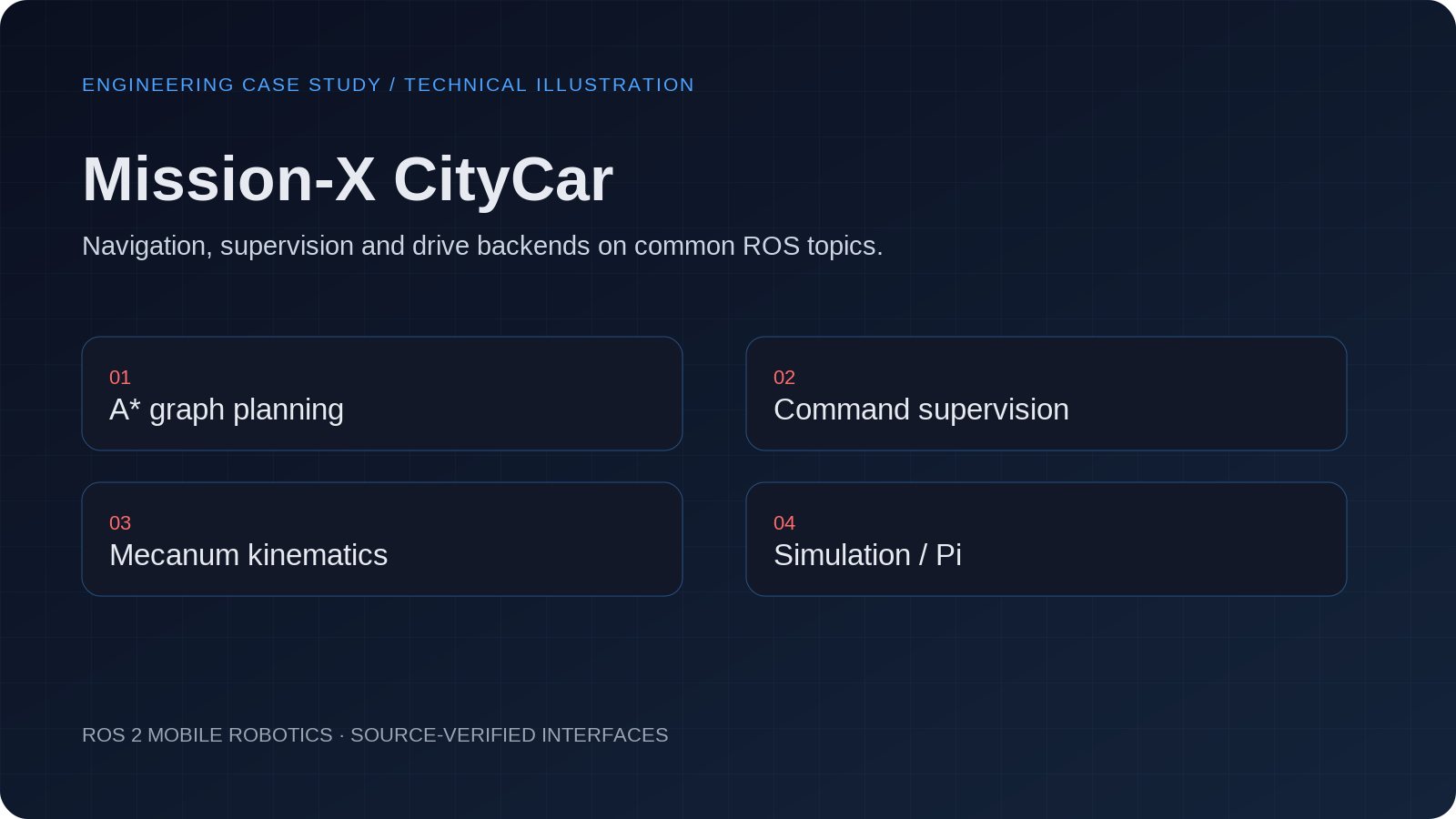
Mission-X CityCar — Autonomous Mobile Robotics Platform
Robotics · 2026
A ROS 2 mobile robotics platform connecting Gazebo city simulation, graph navigation, mecanum-drive control, sensor feedback, and a React control interface. I implemented reusable command and hardware interfaces, with explicit separation between source-supported simulation workflows and Raspberry Pi functionality that still needs measured physical validation.
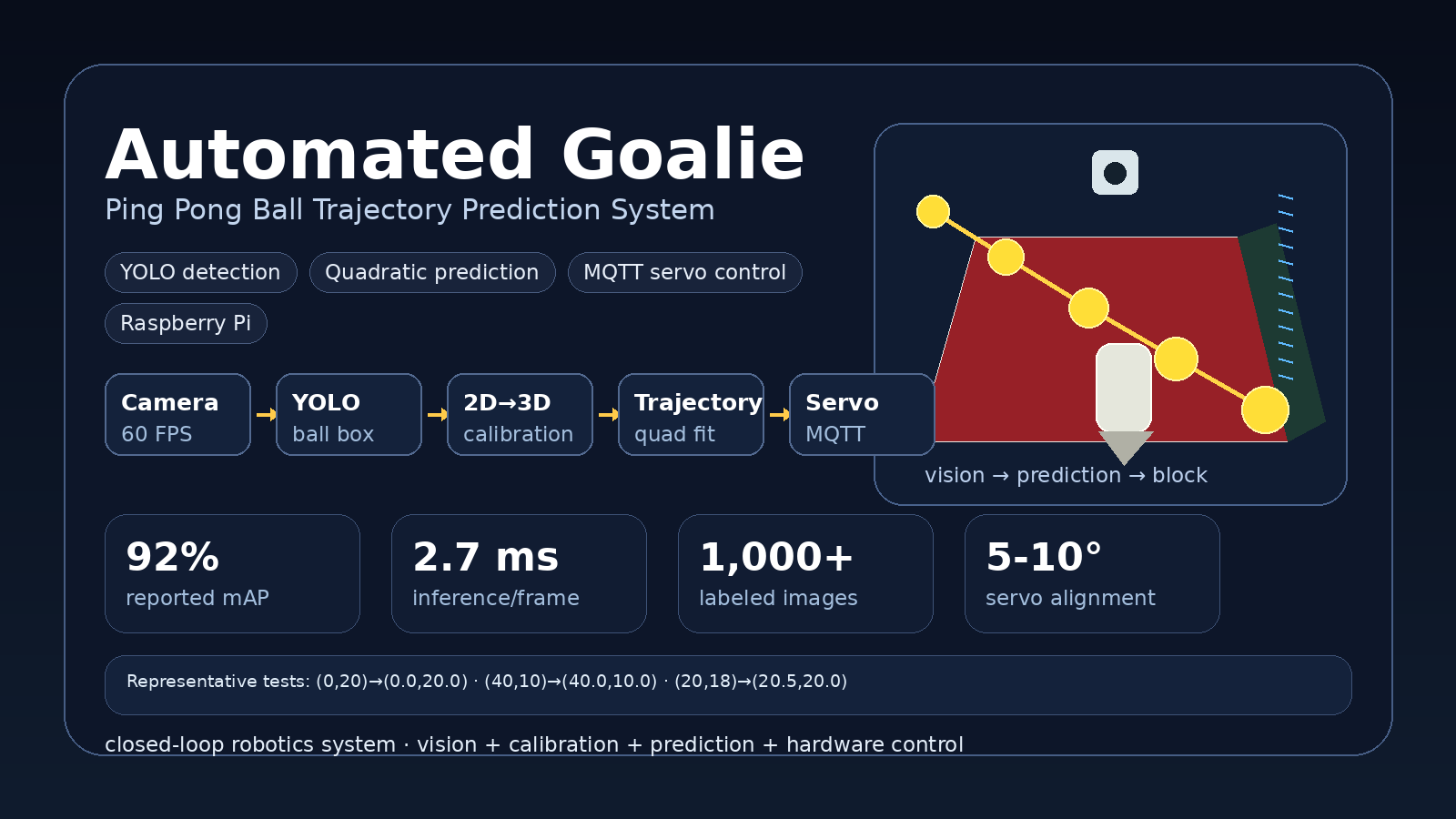
Automated Goalie: Ping Pong Ball Trajectory Prediction System
Robotics · 2025
A closed-loop robot-learning prototype that detects a ping pong ball, estimates its 3D motion, predicts the landing point, and rotates a servo-driven blocker in real time on a Raspberry Pi-based hardware setup.
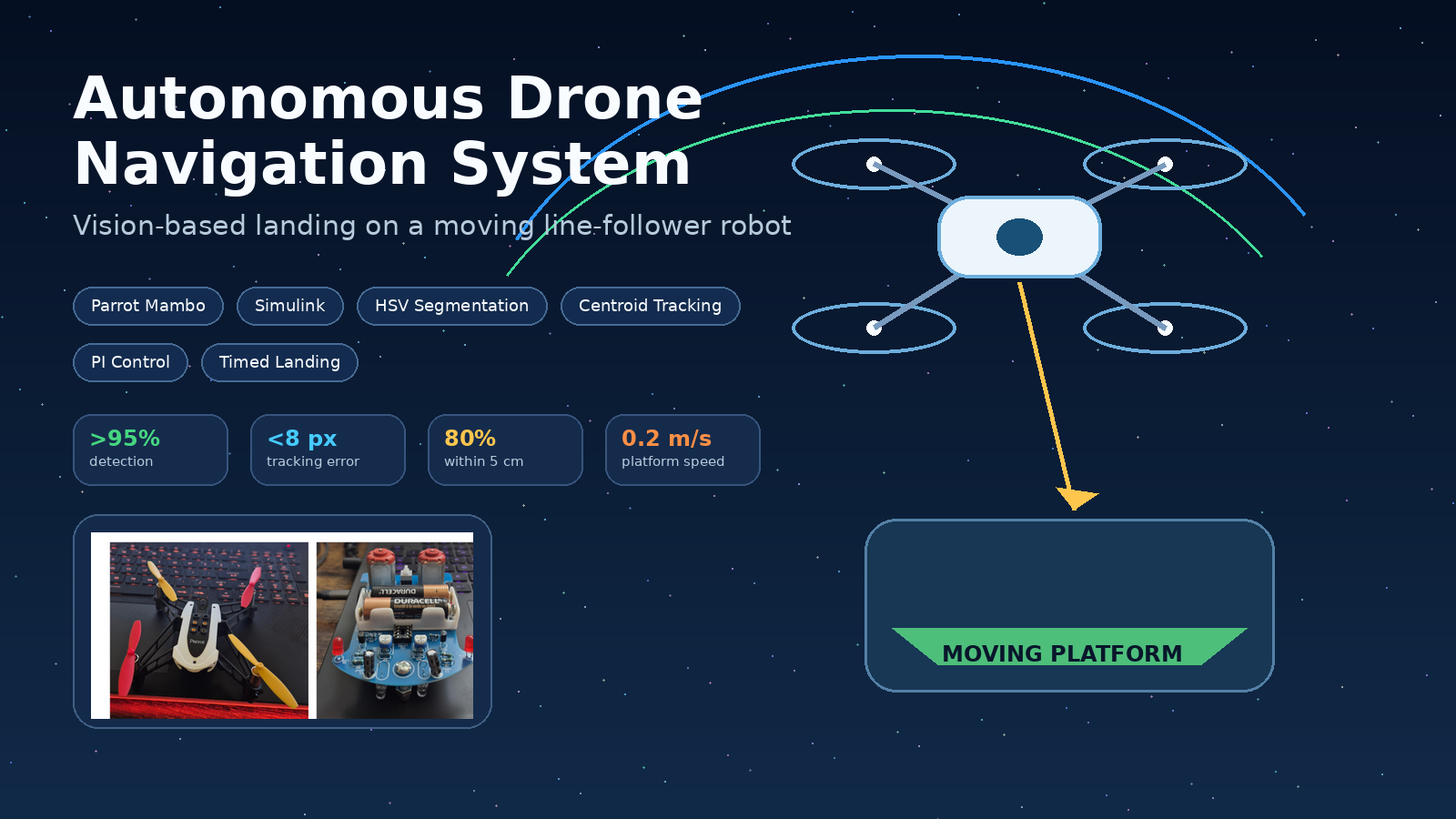
Autonomous Drone Navigation System
Robotics · 2025
A vision-based landing system where a Parrot Mambo drone tracks a moving line-follower robot, stays aligned using image feedback, and executes a timed descent onto the platform.
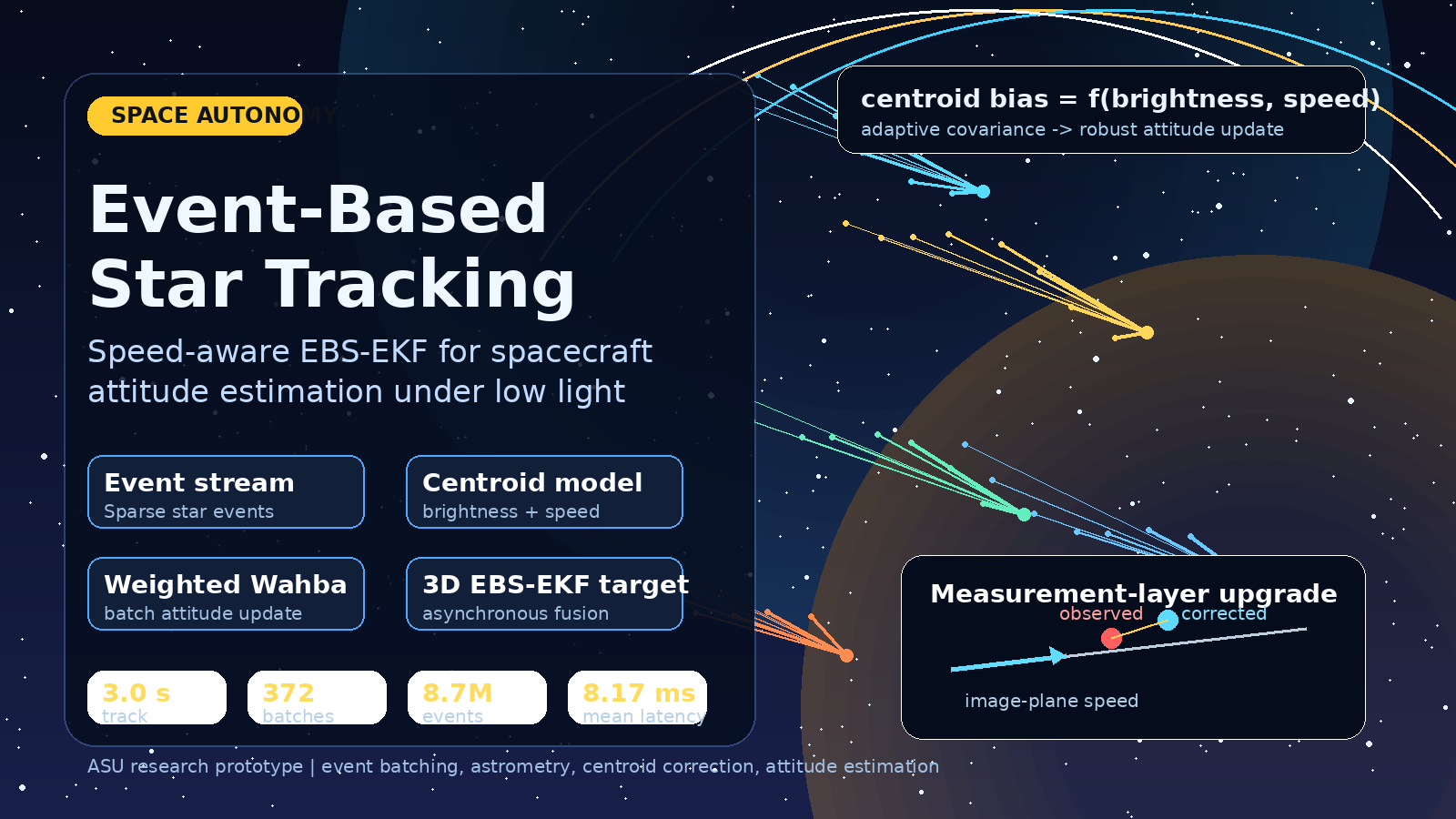
Event-Based Star Tracking for Spacecraft Attitude Estimation
Space Autonomy · 2026
A Speed-Aware EBS-EKF research prototype for event-camera star tracking that improves low-light spacecraft attitude estimation by making centroid correction depend on both brightness and image-plane speed.